


Glue Sticks
Here at Fosseway Tapes, we provide a choice of highly effective, reasonably priced glue sticks. The sticks that we provide are perfect for a number of different uses and include specifications of FSS, HSS, LTS and MPS.
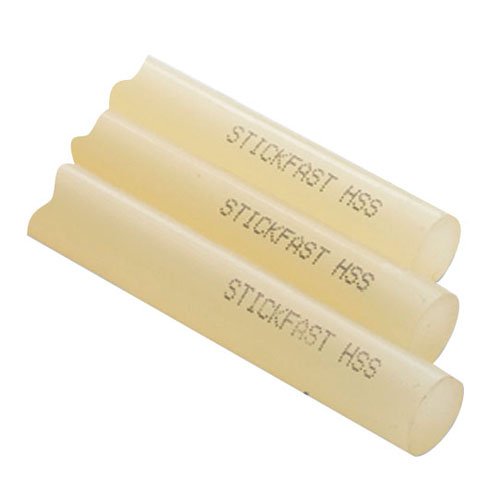
FSS sticks are fast set and are perfect for case and carton sealing. They are odourless and have excellent adhesion to cardboards. HSS are high strength adhesive glue sticks and are perfect for uses that require a little extra grip. Examples include automotive components, ceramic tile displays, product assembly and many more.
Showing all 4 resultsSorted by popularity
-

12mm Stickfast HSS Glue Sticks (5kg Bulk Box) | High-Strength, Fast-Setting Hot Melt Adhesive for Industrial & DIY Applications
From: £5.64 Inc. VAT Select options This product has multiple variants. The options may be chosen on the product page -
12mm x 300mm Tecbond Code 138 Fast Set Glue Sticks | 40% Bio-Based Hot Melt for Packaging, Carton Sealing & POS | FDA Approved | 5kg Box (170 Pcs)
£49.98 Inc. VAT Add to basket -
Stickfast 12mm LTS Low Melt Glue Gun Sticks [10 Pack | Box] | Clear, Fast-Set Hot Melt for Heat-Sensitive Materials, Crafting & Repairs
From: £5.64 Inc. VAT Select options This product has multiple variants. The options may be chosen on the product page -

12mm x 300mm Tecbond Code 136 Multipurpose Glue Sticks | Clear Hot Melt for Deep Freeze (-30°C), Packaging & Upholstery | 5kg Box (Approx. 170 Pcs)
£49.98 Inc. VAT Add to basket

Glue Sticks Explored
Achieving a reliable, swift, and clean bond in commercial applications requires a thermal adhesive that balances open time with rapid cooling dynamics.
Industrial assembly and packaging operations demand solid hot melt sticks that can withstand sudden physical shear forces without losing their molecular grip.
Selecting the correct polymer rod ensures that your substrates remain completely flat, unwarped, and entirely free from brittle joint fracturing.
To discover the ultimate thermal joining solution for your production line, explore our complete trade range of high-performance glue sticks built for industrial application guns.
Why does the melting temperature of a hot melt polymer alter the structural bond strength?
The operational temperature of an industrial glue stick dictates its initial viscosity and its ability to penetrate microscopic surface pores.
Standard hot melts run at around 190°C, a thermal level that allows the liquefied resin to wet-out aggressively on dense, non-porous surfaces.
If the temperature drops too low, the polymer will cool and solidify prematurely before full chemical cross-linking can occur.
This incomplete fusion creates a highly weak, brittle layer that detaches completely under minimal mechanical stress.
How does substrate thermal conductivity cause premature adhesive chilling and joint failure?
Materials like aluminium, steel, and dense hardwoods act as natural heat sinks, rapidly pulling thermal energy away from the applied adhesive bead.
When a hot melt stream hits these cold surfaces, it undergoes a rapid cooling shock, known as thermal chilling.
So what should you consider here?
This instant temperature drop forces the outer skin of the glue to harden into a glassy state before it can bond with the mating material.
Utilising slow-setting polyamide glue sticks or pre-warming your metal components completely prevents this chilling effect, ensuring deep, unyielding joint fusion.
What causes stringing during high-speed adhesive dispensing and how does it compromise neatness?
Stringing occurs when thin, molten spider-web filaments remain suspended between the applicator nozzle tip and the completed workpiece.
This messy phenomenon is usually caused by using a polymer formula with a low cohesive melt index or running a gun below its optimal operating temperature.
These sticky, stray threads cool instantly in mid-air, settling across decorative surfaces and clouding your finished packaging or product aesthetics.
For instance…
Upgrading to high-grade formulations with sharp, clean-cutoff additives ensures the molten stream breaks cleanly the exact moment nozzle pressure stops.
How to Choose the Perfect Glue Sticks?
Selecting the ideal thermal adhesive involves matching the exact rod diameter, chemical base, and set speed to your tooling and substrate chemistry.
An incorrect pairing can lead to melting backing materials, charring inside your heating chambers, or molten glue back-milling out of the gun rear.
You must carefully calculate the processing speed of your assembly line to ensure your staff can clamp parts before the glue skin forms.
Balancing rapid handling tack with long-term environmental resistance will completely transform your daily manufacturing output.
Variations & Types
EVA Hot Melt Sticks
Ethylene Vinyl Acetate formulations are the versatile workhorses of the packaging industry, offering fantastic general-purpose adhesion across card and papers.
These user-friendly rods melt cleanly at standard temperatures, providing a fast, economical seal for high-volume dispatch lines.
They provide incredible initial grab, ensuring carton flaps stay firmly compressed even when subjected to outward spring pressures.
Low Temperature Cool Melt Rods
Operating at a much lower thermal window of around 120°C, cool melt sticks protect delicate, heat-sensitive substrates from scorching or blistering.
They are the premier choice for bonding expanded polystyrene foams, fragile thin films, and delicate electronic components.
The reduced operating heat also minimizes the risk of severe accidental skin burns for workshop operators on busy manual assembly lines.
Polyamide Structural Glue Sticks
Polyamides are heavy-duty, high-performance polymers engineered to withstand immense mechanical loads and aggressive chemical environments.
Once fully cooled, these robust rods form an unyielding, rigid bond line that exhibits exceptional resistance to oils, greases, and fuels.
They excel in product design assembly, automotive trim fixing, and wood joinery where long-term structural durability is non-negotiable.
Specialist Considerations
Dimensional Diameter Tuning and Gun Fitment
Industrial glue sticks are manufactured to precise diameter specifications, with twelve millimetres and fifteen millimetres being the commercial trade standards.
Attempting to force an incorrect rod thickness into an uncalibrated tool feed sleeve will compress the rubber transport rings, triggering an instant jam.
Always verify your specific gun model manual to guarantee smooth, continuous mechanical feeding under high-volume pressures.
Thermal Degradation and Nozzle Char Prevention
Leaving an adhesive gun switched on and idling for extended hours causes the stagnant polymer inside the heating block to degrade.
This continuous thermal cooking breaks down the molecular chains, turning the clean clear adhesive into a black, carbonised crust.
This carbon crust blocks the fine extrusion nozzle and ruins future applications with ugly, discoloured specs of burnt glue.
Substrate Environmental Exposure and Thermal Stability
Standard thermoplastic hot melts can soften and release their structural grip if exposed to hot summer conditions inside unventilated shipping containers.
Conversely, sub-zero winter temperatures can make basic EVA polymers highly brittle, causing the bond line to fracture under transit impacts.
Specifying a specialized wide-temperature formulation ensures the cured resin stays flexible in the cold and tough under heat.
Quality & Brand Selection
Sourcing trade-quality thermal adhesives from trusted industry names like Stickfast prevents expensive product failures and machinery downtime.
Premium glue sticks are drawn from high-purity resins that do not outgas toxic fumes or leave sticky chemical residues on your gun housings.
For an uncompromised, lightning-fast assembly bond across all your commercial operations, browse our complete range of professional glue sticks today.